
CBD Cream Guide: Ingredients, Application & What to Know
Reading Time: 8 minutes
Introduction
CBD creams are topical cannabis products designed to be applied directly to the skin. They are often marketed for sore muscles, joint discomfort, post-activity routines and general skin care, but product claims can sometimes go further than the available research supports.
This guide explains what CBD cream is, how topical products differ from CBD oils and edibles, what current research can and cannot tell us, and what to check before applying a CBD topical. It also covers patch testing, ingredient safety and situations in which persistent pain or skin symptoms should be evaluated by a healthcare professional.
Contents
What Is CBD Cream?
CBD cream is a topical product containing cannabidiol, commonly known as CBD. It usually combines a cannabis extract with a cream, lotion, balm or similar base that can be spread over the skin.
Unlike CBD oils and gummies, topical creams are not normally swallowed. They are applied to a specific area of the body according to the product instructions.
In Canada, CBD is regulated as cannabis regardless of whether it was obtained from hemp. A CBD cream should not be treated as an unrestricted cosmetic or natural health product simply because it is intended for external use.
What Else Can Be Found in a CBD Cream?
CBD is only one part of a topical formula. Depending on the product, a cream may also contain:
- Carrier oils, such as coconut-derived oils or other plant oils;
- Moisturizing ingredients, such as shea butter, glycerin or waxes;
- Cooling or warming ingredients, such as menthol or camphor;
- Botanical extracts and essential oils;
- Fragrances and preservatives; and
- Other cannabinoids, which may include THC depending on the formulation.
These additional ingredients can influence the product’s texture, scent and skin sensation. They can also contribute to irritation or allergic reactions, so the complete ingredient list matters—not only the amount of CBD.
Topical CBD vs. Transdermal CBD
The words topical and transdermal are sometimes used as though they mean the same thing, but they describe different product goals.
| Product Type | General Purpose | Important Consideration |
|---|---|---|
| Topical cream, balm or lotion | Applied to the surface of a particular area of skin | The amount of CBD that moves through human skin can vary significantly by formulation. |
| Transdermal product | Formulated to move an ingredient through the skin | A transdermal formulation should not be assumed to behave like an ordinary topical cream. |
| Oral CBD oil | Measured and consumed according to the product directions | Oral products involve different absorption, safety and medication-interaction considerations. |
A product applied to the skin should not automatically be assumed to enter the bloodstream or affect the entire body. Whether and how deeply an ingredient penetrates the skin depends on the formula, concentration and other ingredients used.
How Might a CBD Cream Affect the Skin?
The skin contains several types of receptors and signalling pathways, including parts of the endocannabinoid system. Researchers are studying how cannabinoids interact with these systems, but the process is more complicated than saying that CBD simply “switches off” inflammation or pain signals.
Any sensation a person notices after applying a cream may also come from other ingredients. Menthol, camphor and similar ingredients, for example, can create cooling or warming sensations independently of CBD. Massage itself may also temporarily change how an area feels.
For this reason, personal experience with a multi-ingredient cream does not establish that CBD alone produced the result.
What Does Research Say About Topical CBD and Pain?
Topical CBD is being studied for localized discomfort and certain pain conditions. Some small human studies have reported encouraging findings, but the overall evidence remains limited.
Researchers have not yet established a standard topical CBD concentration, application frequency or formulation that reliably treats arthritis, chronic pain, muscle soreness or other pain conditions. Products also differ considerably in their CBD content, base ingredients and ability to move compounds through the skin.
Current research therefore does not justify describing every CBD cream as a proven pain treatment. A person may choose to explore a topical product, but it should not delay assessment of persistent, severe or unexplained pain.
What About Post-Workout Soreness?
Muscle soreness after unfamiliar or strenuous activity often improves with time, appropriate rest and gradual recovery. Although CBD topicals are frequently marketed to active adults, there is not enough evidence to guarantee faster recovery or improved athletic performance.
Pain following an injury, significant swelling, weakness, loss of movement or symptoms that do not improve should be assessed rather than repeatedly covered with a topical product.
Can CBD Cream Treat Eczema, Psoriasis or Acne?
CBD creams should not be presented as established treatments for eczema, psoriasis, acne or other diagnosed skin conditions. Research into cannabinoids and skin health is ongoing, but early laboratory findings do not prove that a retail CBD cream will treat a disease in people.
A multi-ingredient cream can also worsen sensitive skin. Fragrance, essential oils, preservatives, menthol and botanical extracts may cause irritation even when CBD itself is not the cause.
People with an active rash, broken skin, infection, persistent itching or a diagnosed skin condition should speak with a physician, dermatologist or pharmacist before introducing a new topical product.
What to Look for Before Using a CBD Cream
| Information to Review | Why It Matters | What to Check |
|---|---|---|
| Total CBD | Shows how much CBD is declared in the container or product | Confirm whether the number refers to the entire container or a concentration. |
| Total THC | Identifies whether THC is present and in what amount | Do not assume that a CBD topical is automatically THC-free. |
| Complete ingredient list | Identifies fragrances, essential oils, preservatives and other active ingredients | Review known allergies and ingredients that have previously irritated your skin. |
| Application instructions | Explains how the particular formulation is intended to be used | Follow the product instructions rather than a general schedule found online. |
| Warnings | May identify restricted areas, storage requirements or other precautions | Read these instructions before the first application. |
| Lot and packaging details | Help identify and trace the product | Keep the original container and label while using the product. |
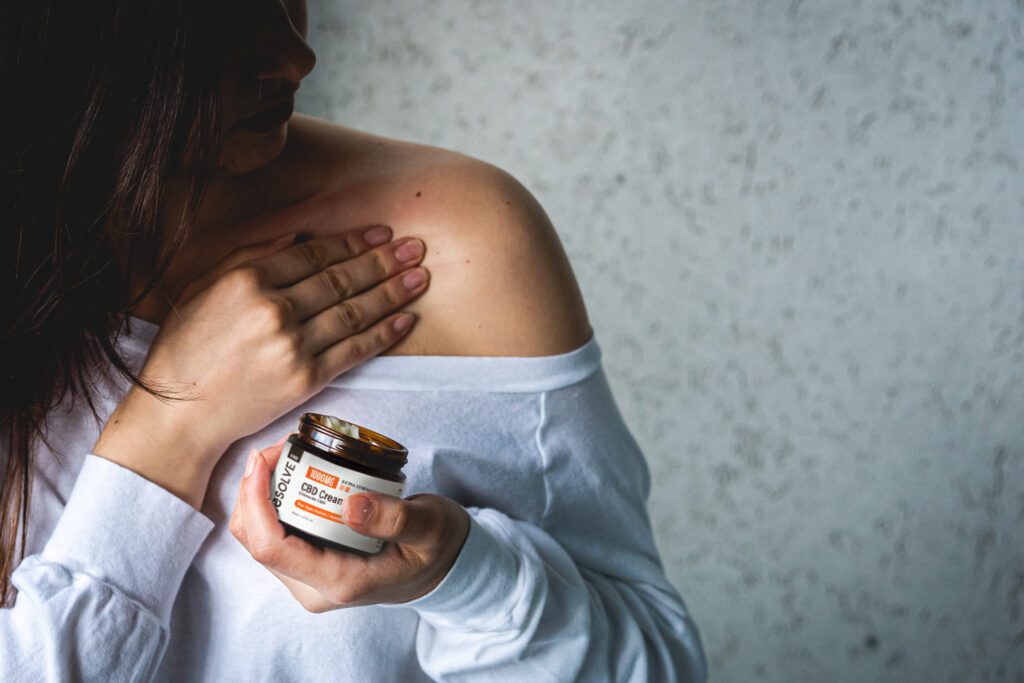
Review the label and application instructions before using a topical product such as ResolveCBD Pain Cream.
How to Apply CBD Cream Carefully
Application directions vary by product. The instructions provided with the specific cream should take priority over general advice found in an article.
- Read the complete label: Check the ingredients, cannabinoid amounts, warnings and application directions.
- Inspect the skin: Avoid applying the product to open wounds, active infections or severely irritated skin unless a healthcare professional has advised otherwise.
- Clean and dry the area: Remove dirt, sweat and other topical products before application.
- Use a small amount initially: Follow the product instructions and avoid covering a large area during the first use.
- Massage gently: Do not aggressively massage an injured, swollen or highly painful area.
- Wash your hands afterward unless the hands are the intended application area.
- Avoid sensitive areas: Keep the cream away from the eyes, mouth and other mucous membranes.
- Monitor the skin: Stop using the product if it causes persistent burning, rash, swelling, blistering or worsening irritation.
How to Patch-Test a CBD Cream
A patch test can help identify an immediate reaction to a new topical product, although it cannot guarantee that irritation will never occur.
- Apply a small amount to a limited area of intact skin.
- Do not apply another new skin product to the same area.
- Follow the product directions and monitor for redness, itching, swelling or discomfort.
- Wash the product off and discontinue use if a concerning reaction develops.
Anyone with a history of serious allergic reactions or severe skin sensitivity should seek professional advice before testing a new multi-ingredient topical product.
How Often Should CBD Cream Be Applied?
There is no universal application frequency that is appropriate for every CBD cream or every person. Formulations differ in concentration and ingredients, so advice such as “apply one to three times daily” should not be used as a general rule unless it matches the instructions for the particular product.
Using more cream or applying it more frequently does not guarantee a stronger result. Excessive use may increase skin irritation or exposure to other ingredients in the formula.
When Should Pain Be Medically Assessed?
A topical cream should not be used to hide symptoms that require assessment. Contact an appropriate healthcare professional when pain:
- began after a significant injury or fall;
- is severe, worsening or repeatedly returns;
- is accompanied by significant swelling, redness or warmth;
- causes weakness, numbness or loss of movement;
- is associated with fever or feeling seriously unwell;
- interferes with normal activities or sleep; or
- does not improve as expected.
Call emergency services for severe symptoms such as chest pain, difficulty breathing, sudden weakness, loss of consciousness or a serious allergic reaction.
CBD Cream Compared With CBD Oil
CBD cream and CBD oil are different product formats and should not be treated as interchangeable.
| Feature | CBD Cream | CBD Oil |
|---|---|---|
| Typical use | Applied to a specific area of skin | Measured and consumed according to the product directions |
| Main formulation | CBD extract combined with a cream, balm or lotion base | CBD extract combined with a carrier oil |
| Ingredient concerns | Fragrance, essential oils, preservatives, menthol and botanical ingredients | Carrier oil, flavouring, CBD and THC concentration |
| Important safety point | Avoid sensitive, injured or highly irritated skin unless directed otherwise | Consider medication interactions and other systemic effects |
Readers comparing topical and oral formats can review the product information for full-spectrum CBD oil after considering the different safety and usage factors.
Frequently Asked Questions About CBD Cream in Canada
Is CBD Cream Legal in Canada?
CBD is regulated as cannabis in Canada regardless of whether it comes from hemp. A CBD topical must be produced, packaged, labelled and sold in accordance with the applicable federal, provincial and territorial cannabis rules.
Does CBD Cream Contain THC?
Some CBD creams may contain THC, while others may be formulated without it. Consumers should check the declared CBD and THC amounts on the label instead of assuming that every CBD product is THC-free.
Will CBD Cream Make Someone Feel High?
CBD itself is not generally considered intoxicating in the same way as THC. However, product composition matters. Read the label carefully and follow all warnings, particularly when a topical contains THC or is designed for transdermal delivery.
Does CBD Cream Work Immediately?
There is no reliable universal onset time for CBD cream. Formulation, ingredients, application area and individual response can all affect the experience. Claims promising relief within a specific number of minutes should be treated cautiously unless supported by evidence for that exact product.
Can CBD Cream Treat Arthritis?
Small studies have explored topical CBD for certain forms of arthritis-related discomfort, but the available evidence is not sufficient to conclude that retail CBD creams consistently treat arthritis. Arthritis symptoms should be discussed with a qualified healthcare professional.
Can CBD Cream Be Used for Eczema or Psoriasis?
CBD cream is not an established replacement for medical treatment of eczema or psoriasis. Some ingredients commonly found in topical products can irritate sensitive or inflamed skin. Consult a healthcare professional before applying a new product to an active skin condition.
Can CBD Cream Be Applied to Broken Skin?
Do not apply a topical CBD product to open wounds, infected areas or severely damaged skin unless the product instructions specifically permit it and a qualified healthcare professional has advised that it is appropriate.
Where Can Consumers Review ResolveCBD’s Cream Ingredients?
The ingredient list, available formats and product-use information can be reviewed on the ResolveCBD Pain Cream product page. Compare that information with the considerations discussed in this guide before deciding whether a topical product is appropriate for you.
Official Resources for Canadian Consumers
- Health Canada: Cannabidiol and industrial hemp
- Health Canada: How to read and understand a cannabis product label
- Health Canada: Cannabis packaging and labelling guide
- Health Canada: Cannabis side effects and safety considerations

Conclusion
CBD cream is a topical format that allows a product to be applied to a specific area of skin. However, that does not mean every cream has been proven to relieve pain, reduce inflammation or treat a skin condition.
Consumers should review the complete ingredient list, CBD and THC information, warnings and application instructions. Patch testing may help identify irritation, and new or persistent pain should be appropriately assessed rather than managed indefinitely with a topical product.
Those who want to review an example of a Canadian CBD topical can consult the ingredient and product information for ResolveCBD Pain Cream after considering the evidence and safety information above.
Disclaimer: This article is provided for general informational purposes only and is not intended as medical advice, diagnosis or treatment. CBD creams and their other ingredients may cause irritation or allergic reactions and may not be suitable for every person or skin condition. Consult a qualified healthcare professional regarding persistent pain, an active skin condition, medication use, pregnancy, breastfeeding or other individual health concerns. Follow the product label and all federal, provincial and territorial laws applicable to cannabis products.
DISCLAIMER: Information and products presented by resolveCBD are not intended to diagnose, treat, cure, or prevent any disease or ailment, nor is it intended to be a substitute or alternative for professional medical advice. Always consult with a licensed professional regarding medical treatment or possible interactions with prescribed drugs. Products are intended to be used as directed, by individuals who are 19 years of age or older.